PRUF.NET Wants to Prove You're Human Without Learning Who You Are
The internet has two problems that increasingly collide: platforms collect too much information about real people, yet they still struggle to keep out bots. PRUF.NET is testing a different bargain. Its new iPhone social network is designed to confirm that a live person is present without asking that person to reveal a name, email address, phone number, password, or government ID.
PRUF Systems opened 10,000 public-beta seats on October 26, 2026. The TestFlight beta is free, limited to adults in the United States, and requires an iPhone with Face ID running iOS 18 or later. There is no Android version during the beta.
What is PRUF.NET?
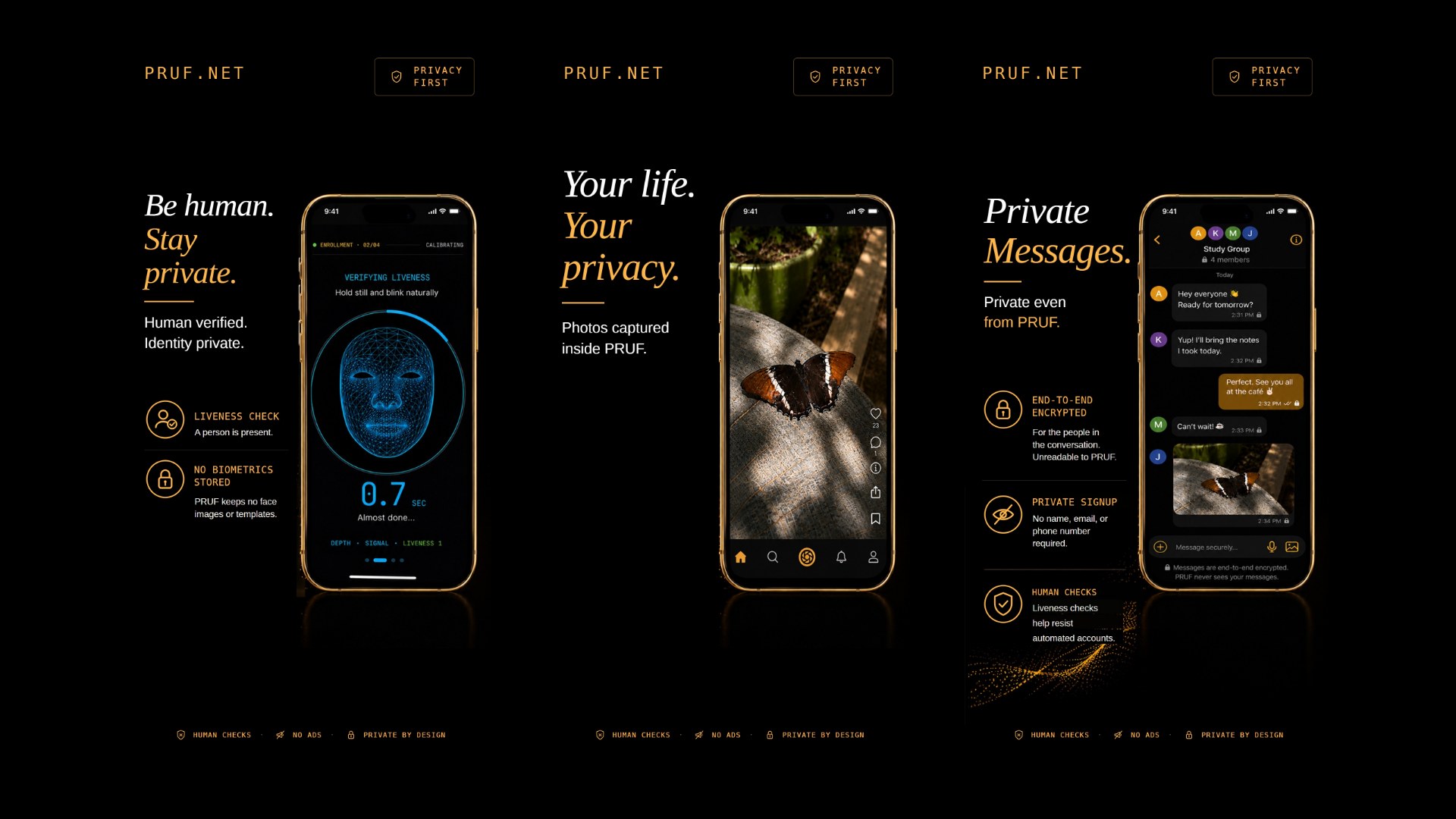
PRUF.NET is the first consumer product from Los Angeles-based PRUF Systems. The company describes its approach as proof of humanity without proof of identity. Instead of creating an account with contact information, a user completes a live-person check on the iPhone, uses Face ID, and selects a public username.
According to PRUF's public fact sheet, Face ID and the liveness check run on the device. The company says it does not receive or store face images or biometric templates. An account is bound to one iPhone, making automated account creation more expensive than generating another email address.
That does not mean PRUF knows nothing about an account. Its privacy policy says it keeps usernames, posts, an internal account ID, the account's metro area, device information, sign-in and diagnostic records, and coded identifiers used for account integrity. It is more precise to call the service pseudonymous and data-minimizing than invisible.
Why the idea is timely
Most proof-of-personhood systems solve the bot problem by increasing identity assurance, sometimes through government documents, payment information, or specialized biometric hardware. PRUF separates two questions: is a live person using this account, and who is that person in the offline world?
PRUF wants an answer to the first question without collecting the answer to the second. If it works at scale, the distinction could be useful beyond social networking. Websites, communities, marketplaces, and AI-agent systems increasingly need to distinguish human intent from automated activity without requiring every visitor to surrender a legal identity.
PRUF Systems says it plans to extend the verification layer to privacy-preserving website access and authorization for AI agents. Those uses are planned, not part of the current beta.
A feed built around captured media
PRUF's feed does not accept images imported from the camera roll. Photos must begin in the app's camera, and each one includes a capture record describing when and where it was made, the iPhone model and camera settings, and any edits. Exported photos can carry a seal and a link back to the original capture.
This is a provenance signal, not a truth detector. PRUF explicitly says a capture record describes how media was created; it does not prove that the scene, caption, or claim is authentic. A person can photograph a screen, stage a scene, or write a misleading caption. The system provides evidence about capture, not a guarantee about meaning.
Private messages and no ads
PRUF says direct messages are end-to-end encrypted, so the company cannot read their contents. Its privacy policy states that encrypted messages may be held for delivery for up to 30 days, while conversation metadata such as participants and send times is retained as needed to operate the service.
The network has no advertising and says it does not sell user information or use posts and messages to train AI. The core network is expected to remain free, with optional subscriptions planned for expanded storage and additional usernames.
The tradeoffs to understand
- It is an early beta. Features may change or break, and the company advises users to keep copies of important content.
- Access is narrow. The beta is for U.S. adults using newer Face ID-equipped iPhones.
- Human does not mean trustworthy. People can still spam, harass, manipulate, or mislead.
- Moderation involves AI. PRUF's terms say an outside AI service reviews media and may create descriptions and search keywords. The company warns that those systems can make mistakes.
- Security claims need scrutiny over time. Patent-pending status is not an independent security certification, and PRUF's privacy and encryption claims currently come primarily from the company.
What makes PRUF different?
Face ID, encrypted messaging, content moderation, and camera metadata already exist elsewhere. PRUF's difference is the decision to combine them around a deliberately small identity footprint. Traditional platforms make accounts easy to create, then use contact information, behavioral signals, and moderation to manage abuse. PRUF makes account creation more hardware-dependent while declining to build a conventional identity profile.
That could reduce cheap bot creation, although organized attackers with devices and people will be a harder test. The beta's real challenge is not simply attracting 10,000 users; it is preserving privacy, resisting abuse, recovering accounts safely, and sustaining healthy communities without falling back on the identity and advertising machinery PRUF was built to avoid.
Who should try it?
PRUF.NET will be most interesting to privacy-conscious iPhone users, people who want smaller social spaces without advertising, and anyone studying human verification or media provenance. It is less suitable for people who need Android access, broad network effects, identity-based professional profiles, or mature platform reliability today.
The bottom line
PRUF.NET proposes a compelling middle ground between anonymous networks that are easy to automate and identity-heavy platforms that collect permanent personal records. Its premise is unusually relevant in 2026: a network should be able to establish that someone is human without needing to know exactly who that human is.
For now, PRUF is a limited public beta and its strongest claims should be judged as the service grows. Still, the architecture is a thoughtful response to a real problem and one worth watching. Eligible iPhone users can learn more at pruf.net.
Sources: PRUF.NET, PRUF Systems press kit, Privacy Policy, and Terms of Service. Product and security descriptions attributed to PRUF are company claims unless otherwise noted.