Meta Shipped a Terminal Coding Agent. The $0.10 Price Tag Is Paid in Source Code.
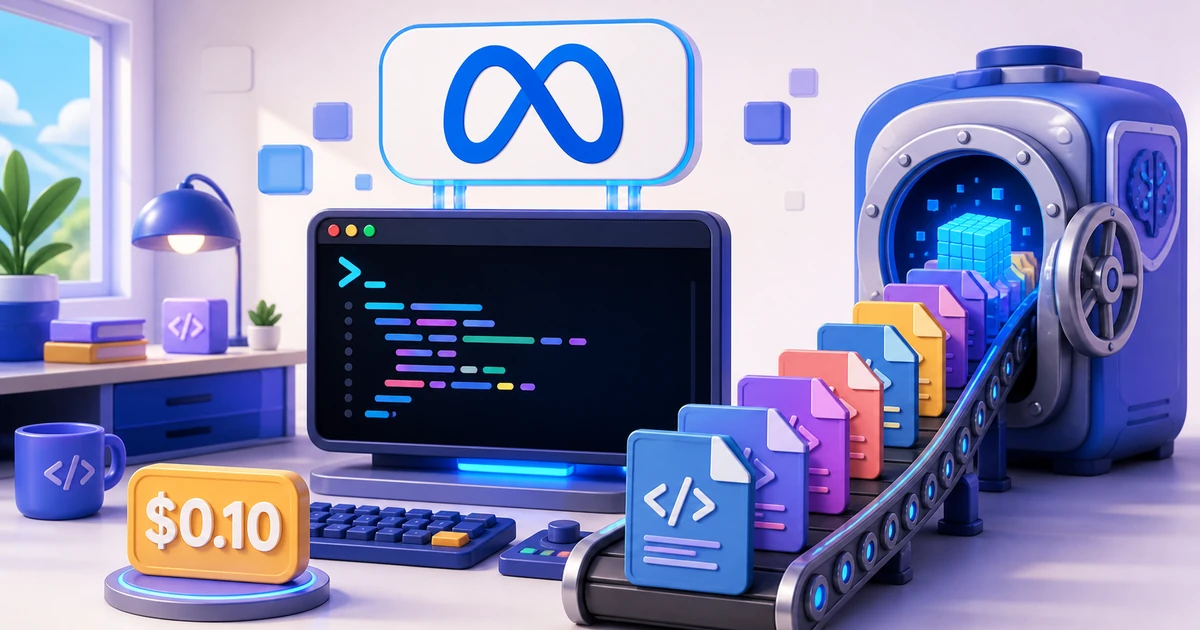
On 5 August 2026, Meta Superintelligence Labs shipped two things at once: Muse Code, a terminal coding agent in beta, and Muse Spark 1.2, the model it was co-trained with. Mark Zuckerberg announced it on X as an agent that "takes on complete software engineering tasks across large repos: planning changes, writing code, validating the results."
Almost every write-up led with the same number: a $0.10 per million token price, more than ten times cheaper than the standard tier. That number is real. It is also the least interesting thing about this launch, and the part of it nobody put in a headline is the part you should read twice.
What Meta actually shipped
Muse Code installs with one line on macOS or Linux — curl -fsSL https://dev.meta.ai/install.sh | bash — and it is not a thin wrapper around an API. Three design choices stand out from Meta's own product docs:
- Persistent background agents. Most harnesses spawn a helper subagent per task and throw it away. Muse Code keeps a set of specialised background agents alive for the whole session, so they stop re-reading the same files every time. They work asynchronously and decide themselves when to report back to the lead agent.
- An append-only event log. Every model call, tool run, approval and edit is appended locally. Meta says this makes the runtime "replay-exact and restart-safe" — kill the session mid-task and it resumes where it stopped instead of starting over. Anyone who has lost a 40-minute agent run to a crashed terminal will understand why this matters more than a benchmark point.
- Locked down by default. Approvals and an OS-enforced sandbox are both on from first run — Seatbelt on macOS, a bundled bubblewrap helper on Linux — and the agent refuses to run a shell command if it cannot confirm the sandbox is active. Network defaults to per-destination approval. Inside your own repo,
.git,.museand.agentsstay read-only so the agent cannot rewrite its own history, config or memory. That is a stricter posture out of the box than most of the field.
Parallel work fans out to subagents that each get their own git worktree under .muse/worktrees/. One caveat worth knowing before you plan around it: in a non-git workspace, the isolation flag is silently ignored and the children share the lead's workspace.
 View Muse Code on appz.com
The benchmarks Meta published — including the ones it loses
Vendors do not usually publish the chart where they come second. Meta published three of them. On all three coding benchmarks in its own launch materials, Muse Spark 1.2 sits behind Anthropic's Claude Opus 5 — including on the internal benchmark Meta built and controls.
| Model (agent used) | Terminal-Bench 2.1 | DeepSWE 1.1 | Meta Internal Coding Bench |
|---|---|---|---|
| Claude Opus 5 (Claude Code) | 86.7% | 65.0% | 79.4% |
| Muse Spark 1.2 (Muse Code) | 82.9% | 59.3% | 70.6% |
| GPT-5.6 Terra (Codex) | 81.8% | 64.8% | 65.4% |
| Grok 4.5 (Grok Build) | 81.6% | 56.6% | n/a |
| Gemini 3.6 Flash (Antigravity) | 78.9% | 40.0% | 63.9% |
| Muse Spark 1.1 (mini-swe-agent) | 76.2% | 53.0% | 68.3% |
Read it carefully and it says something precise. On Terminal-Bench 2.1 — 89 tasks run in an isolated sandbox with an executable verifier, pass@1 averaged over five attempts — the generational jump is real: 76.2% to 82.9%, and second through fourth place are separated by 1.3 points. That is a statistical tie with Codex and Grok Build.
On DeepSWE 1.1, which asks a model to fix real issues across 91 repositories in five languages, the gap stops being cosmetic: 59.3% against 65.0% for Opus 5 and 64.8% for GPT-5.6 Terra. Third place, and not narrowly. The pattern is consistent: strong when the work flows through a terminal, weaker when the work requires reasoning about a bug buried inside a large project.
One methodological note that matters and that most coverage skipped: for Terminal-Bench and DeepSWE, Meta ran each model in its own agent product — Muse Code for Muse, Claude Code for Opus, Codex for GPT, Antigravity for Gemini, Kimi Code for Kimi. Meta says so plainly in its evaluation methodology and acknowledges rivals might score differently under tools tuned for them. So these are not model comparisons. They are bundle comparisons, which is arguably the more honest way to measure something you will actually use — but it means you cannot lift a single number out of this table and call it a model score.
 View Claude Code on appz.com
 View Claude Opus 5 on appz.com
 View Muse Spark 1.2 on appz.com
 View Codex on appz.com
 View Grok 4.5 on appz.com
 View Google Antigravity CLI on appz.com
 View Muse Spark 1.1 on appz.com
Where Meta actually won: price — and what the cheap tier costs you
Muse Spark 1.2 has a 1,048,576-token context window and two price tiers on the Meta developer product page. The tiers are identical models. The only difference is one question: may Meta train on what you send it?
| Per 1M tokens | Standard | Contributor | Difference |
|---|---|---|---|
| Input | $1.25 | $0.10 | 12.5× cheaper |
| Cached input | $0.15 | $0.002 | 75× cheaper |
| Output | $4.25 | $0.20 | 21.25× cheaper |
| Meta trains on your data | No | Yes | — |
Meta's Chief AI Officer Alexandr Wang described the contributor tier as "more than 10 times cheaper" than pay-as-you-go, which if anything undersells the output discount. And the tier is selected by a model id, not a signed data agreement — which means a single string in a config file is the whole consent mechanism for handing your source code to a frontier lab's training pipeline. Point it at a client's proprietary repo by accident and there is no undo button.
Here is the part the $0.10 headline buried: the standard tier is the better story. At $1.25 input and $4.25 output with no rights surrendered, it undercuts Claude Opus 5 ($5 / $25) by roughly 4× on input and nearly 6× on output, and comes in well under GPT-5.6 Terra's post-price-cut $2 / $12. Meta has priced a credible frontier-adjacent coding model at mid-tier rates. That is the number most teams will actually buy on, and almost every write-up chased the other one.
The real signal: the harness is now part of the product
Two years ago a lab shipped weights and an API and left the ecosystem to build the tooling. Anthropic broke that with Claude Code. OpenAI followed with Codex. Google has Antigravity. Moonshot has Kimi Code. xAI has Grok Build. As of last week Meta has Muse Code — installed with a curl command, co-trained with the model inside it, and, like the Muse Spark models, entirely proprietary.
That changes the buying question. You are no longer picking a model and pointing your favourite CLI at it; you are picking a bundle, and the bundle is where the performance now lives. Meta's own numbers make the point: Muse Spark 1.2 gains 6.7 points over 1.1 on terminal tasks partly because 1.1 was measured in a generic harness and 1.2 was measured in the harness it was trained with. It also means switching costs are being quietly rebuilt. Your approval policies, project rules, skills and session logs live in a vendor's format now.
 View Kimi K3 on appz.com
Should you actually try it?
Two honest caveats before you install anything.
First, the evidence base is thin. Two days after launch, total discussion across Hacker News and Reddit amounted to a few hundred comments, with only a handful of first-hand reports from people who ran the CLI itself. Much of what currently ranks for "Muse Code review" is AI-generated filler. Worth separating two different claims: most early praise is about the model consumed through third-party tools, not about Meta's terminal agent.
Second — and we are flagging this as user-reported, not established fact — roughly fifteen developers across Reddit and Hacker News, in Canada, the UK, Australia and Thailand, report that the contributor model id returns Model not found for them, and that a US VPN generally does not help. Meta has published no regional restriction; its only on-record language is "expanded global access," and that statement is about the model, not the tier. No major outlet has confirmed a geographic limit. Treat the $0.10 rate as unavailable until you have personally seen it bill.
A sane evaluation looks like this: run the standard tier, not the contributor tier. Point it at a repo you would be happy to open-source anyway. Give it three tasks you have already solved yourself — a real bug fix, a refactor across several files, and a test-suite failure — and compare wall-clock time and dollars against whatever you use today. Pass rate against your own pipeline is the only benchmark that decides anything.
If you are less interested in driving a terminal agent yourself and more interested in delegating whole workflows — research, reports, recurring ops work — that is a different product category with different tools; Viktor is one of them, and we reviewed it separately.
The one-line version
Meta did not win the benchmark. It came second on two boards, third on one, and published all three anyway — which is more candour than this industry usually offers. What it won is price, and it won it twice: once with a genuinely aggressive standard tier that most coverage ignored, and once with a contributor tier that is not a discount at all but a transaction. Meta is the first major vendor to put an explicit public price on your source code. It is $1.15 per million input tokens.