Intelligence Got Cheaper Last Week. Speed Got a Paywall.
In the space of 48 hours last week, three of the biggest AI labs shipped releases aimed at exactly the same customer: the person running agents in production. On 12 August 2026, SpaceXAI released Grok 4.6. On 13 August, Google shipped Gemini 3.7 Flash and OpenAI, with Cerebras, previewed GPT-5.6 Sol Ultrafast.
Read the three announcements side by side and a pattern falls out that none of them states directly. Frontier-level intelligence keeps getting cheaper — in one case the price literally halved. What is getting more expensive, and in one case is not for sale to you at all, is speed.
What actually shipped
Gemini 3.7 Flash arrived three weeks after 3.6 Flash, which is a startlingly short generation. Google reports gains over its predecessor on production code quality (FrontierCode 1.1: 43.6% vs 34.4%), long-horizon software engineering (DeepSWE v1.1: 65.3% vs 48.6%), enterprise workflow automation (AutomationBench: 30.4% vs 17.0%) and human-preference web dev (WebDev Arena: 1588 vs 1538 Elo). It takes up to 1M input tokens, returns 64k, handles text, images, video, audio and PDFs, calls tools and can drive a computer. It now powers Gemini Spark.
Grok 4.6 came five weeks after Grok 4.5 and is aimed squarely at long-running agents. Artificial Analysis scores it 61 on its nine-benchmark Intelligence Index — up five points from 4.5, and level with GPT-5.6 Sol. It shipped the same afternoon into Cursor, Grok Build, the API, OpenRouter, Vercel and Cloudflare.
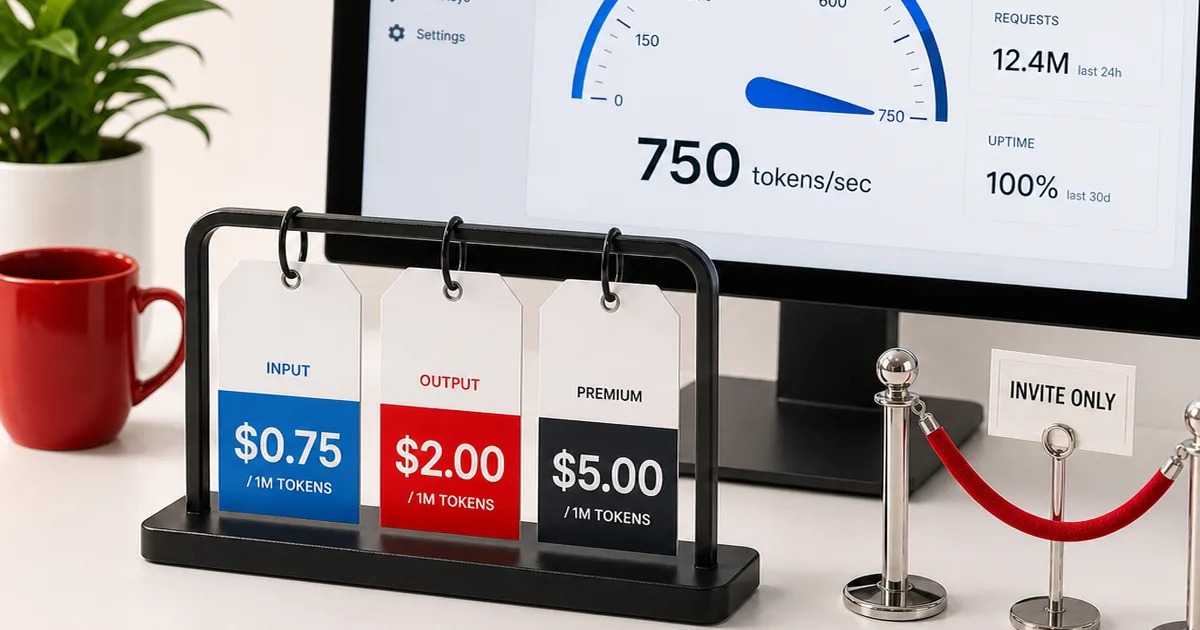
GPT-5.6 Sol Ultrafast is not a model at all. It is a service tier: the same GPT-5.6 Sol, run on Cerebras wafer-scale hardware at up to 750 output tokens per second, which OpenAI puts at roughly 14x its standard speed with no claimed quality loss. It launched in the API, to a selected group of customers, with access expanding “as capacity grows.”
The price of intelligence is falling
Here is the part worth internalising. Set the three releases against the models they compete with and per-token cost has decoupled from measured capability.
| Model | Released | Input / 1M | Output / 1M | Notes |
|---|---|---|---|---|
| Gemini 3.7 Flash | 13 Aug 2026 | $0.75* | $3.75* | Intro price through 31 Dec 2026; $1.50 / $7.50 from 1 Jan 2027 |
| Grok 4.6 | 12 Aug 2026 | $2.00 | $6.00 | Flat vs Grok 4.5; doubles past 200k prompt tokens; fast variant 2x |
| Claude Sonnet 5 | 30 Jun 2026 | $2.00 | $10.00 | Still ahead on knowledge work and computer use |
| GPT-5.6 Terra | Jul 2026 | $2.50 | $15.00 | Balanced tier of the 5.6 series |
| GPT-5.6 Sol | Jul 2026 | $5.00 | $30.00 | Flagship; Ultrafast tier priced separately |
Prices are the vendors' own published API rates as of 17 August 2026. The single most under-discussed line here is Grok 4.6: it ties GPT-5.6 Sol on the Artificial Analysis composite while charging one fifth the output rate. In reasoning-heavy agent work, output tokens dominate the bill, so that is not a rounding difference — it is the difference between a workflow you can afford to run continuously and one you ration.
Gemini 3.7 Flash goes further and simply halves the entry cost, though with an asterisk that deserves reading: $0.75 / $3.75 is an introductory rate that expires on 31 December 2026, after which it doubles to $1.50 / $7.50 — the same standard rate 3.6 Flash already carried. If you are modelling 2027 unit economics on last week's price, you are modelling the wrong number.
And the price of speed is going up
Now put Ultrafast next to that. OpenAI already sells inference speed as a product: a “Fast Mode” on the API at roughly 2.5x speed for roughly double the price. Ultrafast adds a third rung above it. The mechanism is the same one cloud providers have used for a decade — same service, tiered performance, tiered price — applied to tokens.
Two details make this more than a pricing footnote. First, Ultrafast is invite-only. Cerebras wafers are not commodity supply, and OpenAI is rationing access rather than queueing everyone. If your agent's competitive advantage is responding inside a phone call, you cannot simply buy your way in this quarter. Second, OpenAI's own framing is telling: “Until now, getting real-time speed typically meant choosing a smaller or more specialized model.” That is precisely the trade every agent builder has been making — route the cheap fast model for the loop, escalate to the smart one for the hard step. Ultrafast is an offer to stop routing, if you can get in.
The benchmark tables are vendor tables. Read them anyway.
Both Google and SpaceXAI deserve credit for publishing rows they lose, and both benefit from you reading only the headline. Recounting all nineteen rows on Google's own Gemini 3.7 Flash model card: 3.7 Flash wins 9, GPT-5.6 Terra wins 6, Claude Sonnet 5 wins 2 outright, 3.6 Flash wins one against its own successor, and Muse Spark 1.2 takes one. Sonnet 5 keeps GDPVal-AA v2 knowledge work (1598 vs 1525 Elo) and Agent's Last Exam desktop agent tasks (33.3% vs 26.3%). On Terminal-bench 2.1, GPT-5.6 Terra is ahead at 87.4% to 85.8%.
Grok 4.6's own table has a similar shape, and an odd one for a launch pitched at agentic coding: it takes the knowledge-work rows — GDPVal-AA v2, AA-Briefcase, Harvey LAB — and loses the software-engineering ones, trailing GPT-5.6 Sol Max by 7.1 points on DeepSWE v1.1 and 8.6 on Terminal-Bench v3.0. “Matches GPT-5.6 Sol” is true on the nine-benchmark composite and not on the rows you would care about if you were buying it to write code.
| If your workload is… | Strongest bet right now | Why |
|---|---|---|
| High-volume agent loops, tool calls, workflow automation | Gemini 3.7 Flash | Cheapest per token by a wide margin; best reported AutomationBench and WebDev Arena scores |
| Long research runs, legal and knowledge work | Grok 4.6 | Wins GDPVal-AA, AA-Briefcase and Harvey LAB at $6 output |
| Terminal / long-horizon software engineering | GPT-5.6 Terra or Sol | Leads Terminal-bench and DeepSWE rows on both vendors' own tables |
| Desktop and computer-use agents | Claude Sonnet 5 | Agent's Last Exam 33.3%, still the best reported number in Google's table |
| Real-time voice, incident response, live support | GPT-5.6 Sol Ultrafast | 750 tok/s — if you can get an invite |
What this means if you build with these tools
Three practical takeaways.
1. Re-run your routing this month, not this quarter. Gemini 3.6 Flash was three weeks old when 3.7 replaced it; Grok 4.5 lasted five. A routing config written in June is now costing you money on models that have been superseded twice. The cheap step is re-benchmarking your own top three tasks — not the vendor's — against the new prices.
2. Price the January cliff now. Gemini Flash's introductory rate doubles on 1 January 2027. If Flash becomes your default agent brain at $0.75, write the 2027 number into the spreadsheet today.
3. Latency is becoming a procurement problem, not an engineering one. For most of the last two years, if you wanted a faster answer you picked a smaller model and ate the quality loss. That knob is being replaced by a purchase order — and, for now, an invite list. Budget for it, and design so a slow tier still works if your invite never lands.
The apps affected
Every one of these releases lands inside tools people already use daily. Grok 4.6 went live in Cursor and Grok Build the day it launched, and via OpenRouter for everyone else. Gemini 3.7 Flash now powers Gemini Spark. Ultrafast, so far, lands only in the OpenAI API.
 View Gemini 3.7 Flash on appz.com
 View Grok 4.6 on appz.com
 View GPT-5.6 Sol on appz.com
 View Claude Sonnet 5 on appz.com
 View Gemini Spark on appz.com
 View Cursor on appz.com
 View OpenRouter on appz.com
 View Claude Code on appz.com
The bigger shift
For two years the frontier story was a capability race: whose model is smarter. Last week's three releases suggest the interesting axis has rotated. Grok 4.6 held its price flat across a generation. Gemini Flash halved its price and shipped a new generation in three weeks. Neither claimed a decisive intelligence lead, because at the top of the table the gaps are now a couple of composite points wide.
What separates them commercially is delivery: how fast, at what latency, to whom, on what hardware. OpenAI's $10bn Cerebras partnership and the invite list around Ultrafast are the clearest signal yet that inference capacity — not model weights — is the scarce asset. If you are building on top of these models, that is a good thing for your token bill and a complication for your architecture. Plan for cheap intelligence and expensive milliseconds.
We track new model and agent launches as they land on appz.com — follow the tools above to get notified when their next version ships, which on current form will be in about three weeks.